Run Down Acara Super Pesta Buku Murah Solo 2008 "The Spirit of Book"
Graha Wisata Niaga Solo, 06-10 Agustus 2008
Rabu, 06 Agustus 2008
15.00-16.30 : Workshop Keterampilan "Aneka Aksesoris dari Roti Tawar"
oleh Dwi Ani (Gradien Mediatama) di panggung II
19.30-21.00 : Pentas Band "The Glow" Bandung, Games, dan Talkshow
Buku "Kutu Kupret Sandal Jepret; Berani Buang Berani Sial" oleh
Michan (Gradien Mediatama) di Panggung I
Kamis, 07 Agustus 2008
10.00-12.00 : Workshop "Jarimatika" oleh Septi Peni W (Kawan Pustaka)
di Panggung I
Jum'at, 8 Agustus 2008
18.30-20.00 : Talkshow Buku "Mukjizat Gerakan Sholat" oleh Dr.
Sagiran (QultumMedia) di Panggung II
Sabtu, 09 Agustus 2008
10.00-12.00 : Workshop Penulisan Guru #1 oleh Redaksi Agromedia Group
di Panggung I
13.00-15.00 : Workshop Penulisan Guru #2 oleh Redaksi Agromedia Group
di Panggung I
15.30-16.30 : Talkshow "Humor Ganas" oleh Setyawan Tiada Tara
(Indonesia Tera) di Panggung I
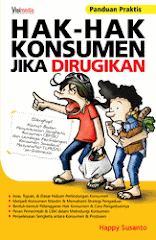
16.00-17.30 : Talkshow Buku "Hak-hak Konsumen Jika Dirugikan" oleh
Happy Susanto (Visi Media) di Panggung II
19.30-20.00 : Talkshow Buku "Istikharah Cinta" oleh Shodik
(QultumMedia) di Panggung II
20.00-21.30 : Talkshow Buku "Asoy, Geboy, Bohay; Cerita Jayus
Mahasiswa Gokil" oleh M. Yudhi (Gradien Mediatama) di Panggung II
Minggu, 10 Agustus 2008
10.00-11.30 : Workshop Keterampilan "Membuat Bross Cantik dari Manik-
Manik" oleh Eryza Susilo (QultumMedia) di Panggung II
11.30-13.00 : Workshop Keterampilan "Aneka Kreasi Kain Flanel" oleh
Retguntari (QultumMedia) di Panggung II
13.00-15.00 : Bengkel Penulisan Remaja oleh GagasMedia di Panggung II
16.00-17.30 : Talkshow Buku "Muka Marketplace" oleh Aca (Bukuné) di
Panggung II
19.00-21.30 : Talkshow Buku "Babi Ngesot" oleh Raditya Dika (Bukuné)
di Panggung II
Monday, August 11, 2008


Saturday, July 12, 2008
Telah terbit buku baru tentang perlindungan konsumen
Buku ini merupakan buku ketiga saya tentang hukum (sebelum membahas hukum nikah Islam dan hukum gono-gini):
Judul: HAK-HAK KONSUMEN JIKA DIRUGIKAN
Penulis: Happy Susanto
Penerbit: Visimedia Pustaka
Terbitan: Juli, 2008
Ukuran buku: 15 x 23 cm
Tebal viii+108 hal
ISBN 979-104-397-3
Harga: Rp 22.500,00
Abstrak:
Pelanggaran terhadap hak konsumen disebabkan beberapa faktor. Di antaranya faktor sikap pelaku usaha yang sering memandang konsumen sebagai pihak yang mudah dieksploitasi dan dipengaruhi untuk mengonsumsi segala bentuk barang/jasa yang ditawarkan. Faktor ini diperparah dengan kurang mengertinya masyarakat umum sebagai konsumen terhadap hak-haknya. Jika haknya diabaikan, konsumen tidak bisa berbuat apa-apa karena memang tidak tahu dan tidak sadar. Ketika sadar, mereka justru tidak mengerti bagaimana tata cara atau prosedur pengaduan dan penuntutan atas hak-haknya yang dilanggar.
Buku ini mengajak kita semua, para konsumen, untuk mencermati masalah-masalah perlindungan konsumen, termasuk soal hak dan tata cara pengaduan jika dirugikan. Buku ini juga dilengkapi prosedur pengaduan yang dapat dilakukan oleh konsumen, serta dilengkapi alamat badan penyelesaian sengketa konsumen (BPSK) dan lembaga perlindungan konsumen swadaya masyarakat (LPKSM) se-Indonesia. Harapannya, konsumen yang dirugikan bisa segera bertindak sebelum kerugian yang ditanggung semakin besar. Dengan kata lain, menjadi bijak sebelum diinjak-injak.
Salam,
Happy Susanto
08174849877
hpysusanto@yahoo.co.id
VISI MEDIA
Jl. H. Montong No. 57
Ciganjur-Jagakarsa
Jakarta Selatan 12630
Phone: 021 788 83030
Fax: 021 727 0996
Judul: HAK-HAK KONSUMEN JIKA DIRUGIKAN
Penulis: Happy Susanto
Penerbit: Visimedia Pustaka
Terbitan: Juli, 2008
Ukuran buku: 15 x 23 cm
Tebal viii+108 hal
ISBN 979-104-397-3
Harga: Rp 22.500,00
Abstrak:
Pelanggaran terhadap hak konsumen disebabkan beberapa faktor. Di antaranya faktor sikap pelaku usaha yang sering memandang konsumen sebagai pihak yang mudah dieksploitasi dan dipengaruhi untuk mengonsumsi segala bentuk barang/jasa yang ditawarkan. Faktor ini diperparah dengan kurang mengertinya masyarakat umum sebagai konsumen terhadap hak-haknya. Jika haknya diabaikan, konsumen tidak bisa berbuat apa-apa karena memang tidak tahu dan tidak sadar. Ketika sadar, mereka justru tidak mengerti bagaimana tata cara atau prosedur pengaduan dan penuntutan atas hak-haknya yang dilanggar.
Buku ini mengajak kita semua, para konsumen, untuk mencermati masalah-masalah perlindungan konsumen, termasuk soal hak dan tata cara pengaduan jika dirugikan. Buku ini juga dilengkapi prosedur pengaduan yang dapat dilakukan oleh konsumen, serta dilengkapi alamat badan penyelesaian sengketa konsumen (BPSK) dan lembaga perlindungan konsumen swadaya masyarakat (LPKSM) se-Indonesia. Harapannya, konsumen yang dirugikan bisa segera bertindak sebelum kerugian yang ditanggung semakin besar. Dengan kata lain, menjadi bijak sebelum diinjak-injak.
Salam,
Happy Susanto
08174849877
hpysusanto@yahoo.co.id
VISI MEDIA
Jl. H. Montong No. 57
Ciganjur-Jagakarsa
Jakarta Selatan 12630
Phone: 021 788 83030
Fax: 021 727 0996
Thursday, June 5, 2008
Observing the Phenomena of Religious Radicalism
By Happy Susanto
The Marriot Hotel’s bombing and previous bombings indicate that the “religious radicalism” movement is a dangerous latent power that suddenly emerges. Violence in the name of religion leads to a situation where religion is enduring a critical historical test. Religion’s pendulum hangs on the perception and behavior of its disciples and swings toward two sides, ‘humanization’ or ‘dehumanization’.
Violence has been occurring for a long time. Violence is used as the effective means to fulfill the desire of individuals or groups of very complex matters. Violence is descending upon religions.
Within the fading attraction of modernity, as conveyed by Max Weber, the attraction of religion is fading too. For a long time, research in Islamic thinking focused on the debate about the relation between tradition (religion) and modernity (transformation)
Anyone who tends to reject modernity and uphold the function of religion’s formal role would tend toward the attitude of ‘fundamentalism’, and vice versa. While people who consider modernity as the only reality which could not be denied by shifting religious role, have a tendency to ‘secularism’; separating religion from the worldly life and separating religion from politics and the state.
Violence results from the polarization of both parties. Violence often is committed by the religious fundamentalist group because they are often marginalized and oppressed by the secular power of the authorities such that there is no other means of struggle except violence.
The Genealogy of Radicalism
Sometimes we often generalize the terms of ‘fundamentalism’ and ‘radicalism’. Yet, both are different although they are originated from the same root. Fundamentalism (al-ushuliyah) is a belief to return to the fundaments of religion. It could be positive or negative. Negative excess caused by the fundamentalist view is an attitude of violence (extreme radicalism).
Radical groups often use violence to fulfill their desire or interest. But, radical groups are not identical to violence. In this article, what is meant as religious radicalism is ‘the rigid religious attitude which contains violence”. It is mentioned in order to simplify the categorization.
The genealogy of religious radicalism appears due to many reasons. In the case of Islam, Hassan Hanafi (2001) mentions that at least there are two reasons behind the violence in contemporary Islam. Firstly, it is due to the oppression of the prevailing political regimes. Islamic groups have no freedom of opinion. Secondly, the failures of secular ideology of the prevailing regime, hence the present of religious fundamentalism or radicalism are considered as ideological alternative as the only choice for Muslim communities.
Violence within religion appears due to the lack of capability to face modernity and transformation. It should be highlighted that fundamentalism is the movement’s spirit of religious radicalism. Reading of fundamentalism has been done by Martin E. Marty and R. Scott Appleby in Fundamentalisms Observed (Chicago and London, 1991). They affirmed that those fundamentalisms are a defense mechanism which appears as a reaction over the threatening crisis. It is the circumstantial crisis that determines their existence. Karen Armstrong (2000) has written also that the growing fundamentalism currently has a strong connection to modernity.
Since radicalism appears as a response to modernity we had better see the relation between tradition and modernity objectively. Modernity contained many negative excess too. We can’t deny that the influence of modernity implicate destruction of humanity’s existence. Modernity should be anticipated. But, anticipation does not cause a total denial in the name of religion. Modernity is a historical phase where there are positive and negative sides.
The solution for violence.
Violence is not a wise strategy for facing the world’s polarization due to the great upshot of modernity. Islam has many thoughtful frameworks for actualizing peace in the world. But exploration over the meaning of peace in Islam is contaminated by several violent attitudes by radical movements. The task of religionists is to find a solution to this violence, since violence is not an Islamic teaching.
The fact that some actors of bombing or terrorism come from religious Islamic groups can be justified by radical Islam. But, is Islam like that? No. whatever is done by the radical Islamic movement contains conditional complexity. It means that under the shield of religion, what they have done is participate in political, ideological and non religious interests. So, it is not due to a narrow religious interpretation.
Using Michael Foucault’s analysis, what has been done by radical Islam group has led religion toward its relation between knowledge and power. The discourse of knowledge of radical Islam group is that God’s law should be implemented in human life. In political terms, the discourse is a unification of ad-dien wad-daulah (religion and state). But the notion (knowledge) of religion is strengthened by the authority’s apparatus. Hence, the movement contains an ideological element. Negative excess due to violence leads religion to have a bad face. That’s why religion and power should be separated.
Since violence is the consequence of modernity, so Peter L. Berger (2003) suggested two strategies for responding to modernity and secularization: ‘religious revolution’ and ‘religion subcultures’. The former is how clerics are capable to transform the society totally and present the modern model of religion. The later is how our effort is to prevent outside influences from affecting religion.
This radical Islam movement emerges due to a rather textual, narrow, and black-white religious understanding. This understanding would easily lead the reader toward a rigid religiosity. Religious reading is being detached from its historical context. Religious understanding is dynamic. That’s why an open reading would deter us from the violence attitude.
Solutions suggested in facing religious radicalism are: firstly, demonstrate Islam as the universal teaching giving direction toward the creation of peace on the earth. Secondly, there must be action to reject violence and terrorism. This action involves all groups within religions which do not desire violence. Terrorism and violence is a form of despising the name of religion and humanity.
Thirdly, it is the time to raise a moderate religious characteristic and understand life’s dynamics by accepting “the other’s” thinking plurality outside of this group. A moderate plurality would eliminate polarization between fundamentalism and secularism in facing modernity and transformation. The middle Islam (ummatan wasathan) would form an Islam characterized by being democratic, open and rational.
Islam fulfills humanity and summons peace as well. It is our task to deliver a positive image for Islam which is indeed humanist and is against violence. Only history would prove whether religion can be present as it is wished for. Wallahu a’lam.
The article retrieved from: http://islamlib.com/en/page.php?page=article&id=657
The Marriot Hotel’s bombing and previous bombings indicate that the “religious radicalism” movement is a dangerous latent power that suddenly emerges. Violence in the name of religion leads to a situation where religion is enduring a critical historical test. Religion’s pendulum hangs on the perception and behavior of its disciples and swings toward two sides, ‘humanization’ or ‘dehumanization’.
Violence has been occurring for a long time. Violence is used as the effective means to fulfill the desire of individuals or groups of very complex matters. Violence is descending upon religions.
Within the fading attraction of modernity, as conveyed by Max Weber, the attraction of religion is fading too. For a long time, research in Islamic thinking focused on the debate about the relation between tradition (religion) and modernity (transformation)
Anyone who tends to reject modernity and uphold the function of religion’s formal role would tend toward the attitude of ‘fundamentalism’, and vice versa. While people who consider modernity as the only reality which could not be denied by shifting religious role, have a tendency to ‘secularism’; separating religion from the worldly life and separating religion from politics and the state.
Violence results from the polarization of both parties. Violence often is committed by the religious fundamentalist group because they are often marginalized and oppressed by the secular power of the authorities such that there is no other means of struggle except violence.
The Genealogy of Radicalism
Sometimes we often generalize the terms of ‘fundamentalism’ and ‘radicalism’. Yet, both are different although they are originated from the same root. Fundamentalism (al-ushuliyah) is a belief to return to the fundaments of religion. It could be positive or negative. Negative excess caused by the fundamentalist view is an attitude of violence (extreme radicalism).
Radical groups often use violence to fulfill their desire or interest. But, radical groups are not identical to violence. In this article, what is meant as religious radicalism is ‘the rigid religious attitude which contains violence”. It is mentioned in order to simplify the categorization.
The genealogy of religious radicalism appears due to many reasons. In the case of Islam, Hassan Hanafi (2001) mentions that at least there are two reasons behind the violence in contemporary Islam. Firstly, it is due to the oppression of the prevailing political regimes. Islamic groups have no freedom of opinion. Secondly, the failures of secular ideology of the prevailing regime, hence the present of religious fundamentalism or radicalism are considered as ideological alternative as the only choice for Muslim communities.
Violence within religion appears due to the lack of capability to face modernity and transformation. It should be highlighted that fundamentalism is the movement’s spirit of religious radicalism. Reading of fundamentalism has been done by Martin E. Marty and R. Scott Appleby in Fundamentalisms Observed (Chicago and London, 1991). They affirmed that those fundamentalisms are a defense mechanism which appears as a reaction over the threatening crisis. It is the circumstantial crisis that determines their existence. Karen Armstrong (2000) has written also that the growing fundamentalism currently has a strong connection to modernity.
Since radicalism appears as a response to modernity we had better see the relation between tradition and modernity objectively. Modernity contained many negative excess too. We can’t deny that the influence of modernity implicate destruction of humanity’s existence. Modernity should be anticipated. But, anticipation does not cause a total denial in the name of religion. Modernity is a historical phase where there are positive and negative sides.
The solution for violence.
Violence is not a wise strategy for facing the world’s polarization due to the great upshot of modernity. Islam has many thoughtful frameworks for actualizing peace in the world. But exploration over the meaning of peace in Islam is contaminated by several violent attitudes by radical movements. The task of religionists is to find a solution to this violence, since violence is not an Islamic teaching.
The fact that some actors of bombing or terrorism come from religious Islamic groups can be justified by radical Islam. But, is Islam like that? No. whatever is done by the radical Islamic movement contains conditional complexity. It means that under the shield of religion, what they have done is participate in political, ideological and non religious interests. So, it is not due to a narrow religious interpretation.
Using Michael Foucault’s analysis, what has been done by radical Islam group has led religion toward its relation between knowledge and power. The discourse of knowledge of radical Islam group is that God’s law should be implemented in human life. In political terms, the discourse is a unification of ad-dien wad-daulah (religion and state). But the notion (knowledge) of religion is strengthened by the authority’s apparatus. Hence, the movement contains an ideological element. Negative excess due to violence leads religion to have a bad face. That’s why religion and power should be separated.
Since violence is the consequence of modernity, so Peter L. Berger (2003) suggested two strategies for responding to modernity and secularization: ‘religious revolution’ and ‘religion subcultures’. The former is how clerics are capable to transform the society totally and present the modern model of religion. The later is how our effort is to prevent outside influences from affecting religion.
This radical Islam movement emerges due to a rather textual, narrow, and black-white religious understanding. This understanding would easily lead the reader toward a rigid religiosity. Religious reading is being detached from its historical context. Religious understanding is dynamic. That’s why an open reading would deter us from the violence attitude.
Solutions suggested in facing religious radicalism are: firstly, demonstrate Islam as the universal teaching giving direction toward the creation of peace on the earth. Secondly, there must be action to reject violence and terrorism. This action involves all groups within religions which do not desire violence. Terrorism and violence is a form of despising the name of religion and humanity.
Thirdly, it is the time to raise a moderate religious characteristic and understand life’s dynamics by accepting “the other’s” thinking plurality outside of this group. A moderate plurality would eliminate polarization between fundamentalism and secularism in facing modernity and transformation. The middle Islam (ummatan wasathan) would form an Islam characterized by being democratic, open and rational.
Islam fulfills humanity and summons peace as well. It is our task to deliver a positive image for Islam which is indeed humanist and is against violence. Only history would prove whether religion can be present as it is wished for. Wallahu a’lam.
The article retrieved from: http://islamlib.com/en/page.php?page=article&id=657
Kelantan Sultanate
1. History
Little is known about the early years of Kelantan history. Some records and notes kept by the European and the Chinese people snap only parts of Kelantan’s picture in the past. They tell us about the origin of Kelantan as an administered land. Below are the aforementioned brief records:
1. According to the records of Claudius Ptolemy, the Greek geographer and astronomer, in his book Geography of Eastern Asia written in the second century, there are three locations laid in the East shore of Semenanjung Melayu (Malay Peninsula): “Kole Polis”, “Primula”, and “Tharra”.
2. G.E. Gerini, an Italian researcher, said that “Kole Polis” located in Kelantan. He contended that the name of Kelantan is derived from two combined words: “Kolo” and “Thana” or “Tanah” to become “Kolathana”, “Kolamtanah”, or “Kolantan”.
3. The Chinese writings, since the 6th century, have mentioned Kelantan in various ways. In the Liang Kingdom period (502-557 A.D), the Chinese said “Tann-Tann”, referring to Kelantan. While in the period of Sung Kingdom (960-1279 A.D), Kelantan was called as “Chi-lan-chau” or “Chi-lan-tan”. In the early 17th century, the Chinese said “Ko-lan-tan”, or “Ku-lan-tan”, all of which refer to Kelantan.
4. Besides “Tan-Tan” or “Tann-Tann”, there is a land often mentioned by the Chinese, namely “Chit-tu”, meaning Negeri Tanah Merah (The Red Land). It was associated with Negeri Kelantan.
Many geographers, based on topographic and geographic consideration, contended that Chit-tu (Tanah Merah) or Raktamrittika was the Kelantan. A European historian, Paul Wheatley, was in line with the premise that Chit-tu was located in Kelantan. He based his statement on the early years of Raktamrittika Kingdom history, established by King Gautama in the 6th century. The King was the son of King Kalahtana. Chit-tu once was one of the Funan Kingdom’s colonies. Kelantan, in 1225 A.D, had ever been under the authority of Crivijaya Kingdom.
Historically, in 1411 A.D. (814 H) Negeri Kelantan was ruled by the first King named King Kumar. Some historians still have wider debate over the genealogy of King Kumar. There is only one record confirming the King Kumar’s relations with one of the Chinese Kings. For example, in 1412 A.D, it is stated that King Kumar had ever received gifts included silk and diplomatic letters from a Chinese King
King Kumar, who passed away in 1418 A.D, was succeeded by Sultan Iskandar Shah, the grandson of King Culan. According to the manuscript of Sejarah Melayu (Malay History), Culan was the King of Negeri Ganggayu or Klang Kio, located in the upper course of Johor River. Another reference, Ringakasan Cetera Kelantan (Summary of Kelantan History) written by Nik Mahmud Ismail, revealed another opinion saying that King Culan was the King of Negeri Perak. Up to now, still not found yet the sufficient data confirming what kinds of relation between King Kumar and Sultan Iskandar Shah. In addition, there is no sufficient evidence explaining the way Islam came to the land of Kelantan, considering that the second ruler, Sultan Iskandar Shah, had embraced Islam.
After Sultan Iskandar passed away in 1465 A.D, the Kelantan was leaded by Sultan Mansur Shah. There are three versions of premises confirming the cognation of Sultan Mansur Shah with Sultan Iskandar Shah. The first version, cited from “Sejarah Melayu”, mentioned that Sultan Mansur Shah was the son of Sultan Iskandar Shah’s cousin. The second version, from “Ringkasan Cetera Kelantan”, contended that Sultan Mansur Shah was the son of Sultan Iskandar Shah. The last version, “Sejarah Negeri-Negeri Melayu” (History of Malay Kingdoms) written by Haji Muhammad Sidi Haji Muhd. Rasyid, mentioned that Sultan Mansur Shah was the cousin of Sultan Iskandar Shah.
The Kelantan Sultanate entered its golden age during the period of Sultan Mansur Shah, especially in terms of its economic growth, depending largely on the agricultural sector. The Kelantan’s prestige was heard to the Malacca Sultanate, ruled then by Sultan Mahmud Shah. In 1477 A.D., he ordered the armed troops to attack the Kelantan Sultanate. Sultan Mansur Shah, at the time, had three sons: Raja Gombak, Unang Kening who married later on to Sultan Mahmud Shah, and Cubak. Sultan Mahmud Shah and Unang Kening had three sons, namely Raja Mah (daughter), Raja Muzaffar (son), and Raja Dewi (daughter). Raja Muzaffar who was born in 1505 A.D., became the Sultan Perak I with title Muzaffar Shah (1528-1540 A.D.). Raja Gombak replaced his father, Sultan Mansur Shah, who passed away in 1526 A.D., as the forth Sultan Kelantan, bearing the title Sultan Gombak (1526-1584 M).
In 1548 A.D, Raja Ahmad, bearing the title of Sultan Ahmad, replaced the position of Sultan Gombak, who passed away, as the next Sultan. Sultan Ahmad, the grandson of Sultan Gombak, married to Cik Banun, the youngest daughter of Kelantan Nobleman Seri Nara Diraja. They had a daughter named Cik Wan Kembang. When Sultan Ahmad passed away in 1588 A.D., Cik Wan Kembang had been four years old. Therefore, Raja Hussin, the son of Raja Umar bearing the title of Sultan Ala Jalla Abdul Jalil Shah (King Johor, 1580-1597 A.D.), was asked to come to Kelantan to be the next (the sixth) Sultan of Kelantan with title Sultan Hussin. However, another source reveals that the coronation of Sultan Hussin was not proposed by then Kelantan administration. By then, in the 16th century, the Kelantan was one of the colonies of Johor.
After Raja Hussin passed away in 1610 A.D., Cik Wan Kembang had reached the mature age and been installed as the seventh Sultan of Kelantan (1610-1663 A.D.). She was the first female Sultan in Kelantan. When she ruled the Sultanate, he settled in Mount Chinta Wangsa, Ulu Kelantan, located about 40 kilometers to the South East of Kuala Krai. The strategic location of the central Sultanate lured the domestic merchantmen and foreign traders to visit Kelantan, boosting its economic growth.
During the period of Cik Wan Kembang, a small kingdom, named Jembal, had established in the North-east part of Kelantan. The Jembal Kingdom was ruled by Raja Sakti (1638 A.D). He was the foster child of Raja Bersiung Kedah. Raja Sakti died in 1649 A.D., and be replaced by his son, Raja Loyor. Cik Wan Kembang established close relation with the Jembal Kingdom especially with Raja Loyor. She, even, had adopted Princess Saadong, the daughter of Raja Loyor, as her foster daughter. After Cik Wan Kembang died in 1663 A.D., the Kelantan Sultanate was no longer ruled by the offspring of Sultan Iskandar Shah. The Kelantan’s ruler also no longer used Sultan, but King to name the higher position. The Kelantan afterwards was ruled by the Kings of Jembal.
Regarding Princess Saadong, the foster daughter of Cik Wan Kembang, she married to King Abdullah, her cousin, after being persuaded by Cik Wan. They lived in Tegayong City (Tanah Serendah Sekebun Bunga Cherang Tegayong), and then moved to Jelasin City in Mahligai Region. She had ever been kidnapped by Commander of Siam named Phraya Decho to be brought to Narai Maharaja Siam (1656-1688 A.D.). The reason for kidnapping is still unknown. When going back to Kelantan, Princess Saadong had several arguments with her husband. King Abdullah died of puncture of hair bun’s Saadong. It was done unintentionally. Afterwards, Princess Saadong installed King Abdul Rahim, King Abdullah’s brother, as the Sultan in Mahligai City.
Not much literature confirm the ruling period of King Loyor. He passed away in 1675 A.D. He was replaced by his brother, Temanggung Umar, bearing the title King Umar (1675-1719 A.D.). He had five sons, namely Raja Kecil Sulung, Raja Ngah with title Raja Hudang, Raja Nah, Raja Sakti, and Raja Pah. Being left by King Umar in 1719 A.D., Long Besar or Long Bahar was installed as the next King in Jembal (1719-1733 A.D.). This installation was proposed by the oldest daughter of King Umar, Raja Kecil Sulung. Long Bahar was the son of Raja Petani (Wan Daim) who bore the title of Datuk Pengkalan Tua. He had ever made a journey to the Kelantan Sultanate, together with his father. Long Bahar married to Raja Pah, the daughter of Sultan Omar.
Long Bahar passed away in 1733 A.D. His position was replaced by his son, Long Sulaiman or Wan Anom Long Nik, bearing the title of Mas Kelantan. Long Sulaiman had three sons namely Long Yunus, Tuan Dewi, and Tuan Kembang. The last married to Long Deraman, the son of Tuan Senik Getting who ruled Legeh region. In 1756 A.D., a mysterious war broke out, aiming at overthrowing Long Sulaiman, who was murdered in the war. His position was then replaced by his cousin, Long Pendak as Raja Kubang Labu. Whereas his brother, Long Muhammad, was installed as Raja Muda.
In 1758 A.D., Long Pendak passed away, murdered by Long Deraman for taking revenge. Long Pendak was accused of killing his own wife and Long Deraman’s brother named Tengku Tengah. Long Muhammad, then, replaced the Sultan Position, becoming the King in Kubang Labu City. During his period, some wars and conflicts broke out between Long Muhammad, who was assisted by Long Deraman, and Long Yunus, who was assisted by Long Gaffar, prince of King Reman in Hulu Perak. In 1762 A.D., both Long Muhammad and Long Deraman were killed in a fierce war. Finally, Long Yunus gained the full control of Kubang Labu Kingdom. As a reward, Long Yunus appointed Long Gaffar as Perdana Menteri (Prime Minister) in Kelantan who ruled from Jeram to Pasir Tumbuh.
Long Yunus took the lead of Kelantan Sultanate between 1775 A.D and 1794 A.D. He was famous for his great capability in unifying the whole territory of Kelantan, which was once separated from the central Sultanate. He could make them submit to the one governmental system.
2. Sultans of Kelantan
Below are the Sultans who had ever ruled the Kelantan Sultanate. The list is codified systematically according to the tenure of each Sultan:
1. King Kumar (1411-1418 A.D)
2. Sultan Iskandar (1418-1465 A.D)
3. Sultan Mansur Shah (1465-1526 A.D)
4. Sultan Gombak (1526-1584 A.D)
5. Sultan Ahmad (1584-1588 A.D)
6. Sultan Hussin (1588-1610 A.D)
7. Cik Wan Kembang (1610-1663 A.D)
8. Raja Loyor (1649-1675 A.D)
9. Raja Umar (1675-1719 A.D)
10. Long Besar or Long Bahar (1719-1733 A.D)
11. Long Sulaiman (1733-1756 A.D)
12. Long Pendak (1756-1758 A.D)
13. Long Muhammad (1758-1762 A.D)
14. Long Gaffar (1762-1775 A.D)
15. Long Yunus (1775-1794 A.D)
16. Sultan Muhammad (1794-1839 A.D)
17. Sultan Muhammad II or Sultan Mulut Merah (1839-1886 A.D)
18. Sultan Muhammad III (1886-1900 A.D)
19. Sultan Muhammad IV or Long Senik bin (son of) Long Kundur (1900-1920 A.D)
20. Sultan Ismail (1920-1944 A.D)
21. Sultan Ibrahim (1944-1960 A.D)
22. Sultan Yahya Petra (1960-1979 A.D)
23. Sultan Ismail Petra (1979 A.D - now)
3. Sultanate Period
The Kelantan Sultanate have existed for about six centuries. During that period, Kelantan had experienced the political cleavage, beginning from the period of Cik Wan Kembang (1610-1663 A.D). The separation commenced when Jembal Kingdom proclaimed its independence from the Kelantan. By then, Kelantan was gradually overwhelmed with the wave of Patani wanderers who migrated from their region. The migrant could dominate the government in the period of Long Bahar. Long Yunus, the 15th ruler, could finally restore the Kelantan Sultanate’s power and made it as a unified territory.
In the history of modern Malaysia, the Kelantan Sultanate is one of the 14 Negeri (States) under the federation of Malaysia Kingdom. Kelantan is also called as Negeri Kelantan Darul Iman, which is ruled now by Sultan Ismail Petra (Since 1979 A.D)
4. Sultane Territory
The territory of Kelantan Sultanate covered the below region: Gua Musang (8,177 km2), Kuala Krai (2,277 km2), Jeli (1,318 km2), Tanah Merah (880 km2), Pasir Mas (569 km2), Machang (527 km2), Pasir Puteh (424 km2), Kota Bharu (394 km2), Bachok (279 km2), and Tumpat (177 km2). The Kelantan Sultanate located North-East of Semenanjung Malaysia (Malay peninsula), facing directly the South China Sea, bordered by Southern Thailand.
5. Sultanate Structure
The structure of Kelantan Sultanate was inherited from the traditional Malay political system, in which the Sultan held the highest authority of Sultanate mandate. In administering the government, he was assisted by three clusters of Sultan assistants, namely:
1. Cluster of Sultan’s relatives; they are the offspring of the Sultan.
2. Cluster of noblemen; Those people bore title syed, nik, and wan.
3. Cluster of commoners who hold high position in the Kelantan sultanate.
Their main job was to do all of their responsibilities and to carried out the direct order of Sultan. Their responsibilities included the palace’s custom affairs, administration, financial, legal, security, and foreign relations. One of the main jobs for the cluster of Sultan’s relatives is to install the Sultan who will rule the Sultanate.
The above structure was effectively stipulated at the end of the 18th century, during the period of Long Yunus (1775-1794 A.D). He appointed his sons as such: Long Ismail (as Raja Muda), Long Jenal (as Treasurer), Long Tan (as Temenggung). His close friend, Long Ghafar, was appointed as Mangkubumi and Panglima Perang (Commander) bearing the title Tengku Sri Maharaja Perdana Menteri. Besides, there were other for positions: Raja Bukit Pancor (assumed by Long Yunus bin Long Yunus), Tengku Kota (assumed by Long Muda or Tuan Dagang bin Long Yunus), and Dato’ Kaya Hulubalang (assumed by son of Penghulu Adas).
In the period of Sultan Muhammad the Second, or Sultan Mulut Merah (1839-1886 A.D), the then political structure experienced slight change with some additional positions and new titles, like below:
1. Sultan (Tuan Senik Mulut Merah)
2. Sultan Dewa (Tuan Senik Kota or Tuan Senik Penambang-baharu)
3. Hakim/Judge(Syed Jaafar-baharu)
4. Mufti/Religious Adviser (Tuan Abdul Rahman Muda bin Wan Othman-baharu)
5. Kadi/ (no sufficient data)
6. Perdana Menteri/Prime Minister (Engku Limbat bin Long Jaafar)
7. Pembantu Menteri Besar/Deputy of Prime Minister (Nik Abdul Majid atau Wan Abdul Majid bin Wan Yusuf bersama Nik Yahya)
8. Juru Tulis Diraja (the palace writer) or Setiausaha Sultan (Wan Abdul Kadir)
9. Ketua Istiadat (Head of customary affair) with the title of Dato Megat Mahkota
(picture)
The Gate in the Balai Besar Palace.
In 1845 A.D, the above political system was changed along with the initiation of Jamaah Ahli Mensyuarat (Discussion team), whose members come from Sultanate officials. The major change was effective after the establishment of Bandar Kota Bharu (City) and Istana Balai Besar (Palace) in 1844 A.D. Below are the job desk for each positions:
1. Financial affairs, administered by:
1. Bendahara (treasurer) (conferred with Tengku before his name if the treasurer is one of Sultan’s offspring)
2. Seri Maharaja (conferred with Tengku before his name if the treasurer is one of Sultan’s offspring)
3. Seri Pakerma Raja
4. Seri Akar Raja
2. Military affairs, managed by:
1. Temenggung Aria Pahlawan
2. Seri Nara Diraja
3. Laksamana (Admiral)
4. Seri Kelana Diraja
3. Political affairs, administered by:
1. Seri Paduka Raja
2. Seri Amar Diraja
3. Seri Setia Diraja
4. Seri Diraja
4. Foreign affairs, run by:
1. Biji Sura
2. Biji Wangsa
3. Lela Utama
4. Lela Negara
5. Domestic affairs, arranged by:
1. Kaya Perba
2. Kaya Pahlawan
3. Kaya Hulubalang
4. Kaya Perwira
6. Administrative affairs (in palace), run by:
1. Seri Rakna Diraja
2. Bentara Guna
3. Penghulu Balai
7. Legal affairs, arranged by:
1. Senior Judge (borne by Hakim)
2. Kadi (responsible for Islamic law/Shariah affairs)
3. Hakim (Responsible for non-Shariah affairs)
8. Sultan Consultants:
1. Tengku Bendahara (similar to treasurer)
2. Tengku Temenggung
3. Seri Paduka
The person who would replace the incumbent Sultan bore the title Raja Muda (literally means the Young King). In the Sultan Muhammad the fourth’s administration (Long Senik bin Long Kundur 1900-1920 A.D), 1911 in exact time, the title of “Raja Kelantan” was given to the candidate Sultan. But in 1944 A.D., by the suggestion of some advisers, the title was no longer used. It was so since many people assumed that the candidate would take the Sultanate’s responsibilities in the absence of Sultan when going abroad. The people thought that Raja Kelantan (Candidate) and Sultan Kelantan (The incumbent Sultan) were the same. Tengku Ibrahim, bearing the title Raja Kelantan, ascended the throne of kelantan Sultanate in June 1944 A.D. The title for the candidate was changed to the previous title: Raja Muda.
6. Socio-cultural Life
According to the 2005 census of central government, the total population of Kelantan Darul Iman amounted about 1,373,173 people, consisting of: Gua Musang (80,167), Kuala Krai (97,836), Jeli (38,185), Tanah Merah (108,228), Pasir Mas (172,692), Machang (82,653), Pasir Puteh (111,001), Kota Bharu (425,294), Bachok (116,128), Tumpat (140,989). The Malay, about 95%, constitutes the biggest majority of Kelantan population, while the rests place the second, the third etc, namely Chinese (3,8%), Indian (0,3%), and others (0,9%). Islam is embraced by most of Kelantan citizens, for about 95 % of total population. Buddha ranks the second (4,4%), Christianity and Hindu the third (0,2% respectively), and other religion (0,2%).
Agriculture and industry are the main livelihood of Kelantan population. In terms of agriculture, the population rely mostly on the sap, oil palm, and paddy. The wood industry, especially round timber, and plywood is the main revenue of Kelantan.
The Kelantan Sultanate had strong relation economically and politically with the Patani Sultanate. Geographically, the two sultanates are very close. In terms of culture, Kelantan adopted a multicultural system, combinative of Malay, Islam, and Siam culture. Among the form of acculturation are folk games of Dikir barat, Main Puteri, Mak Yong, and other. Mak Yong, specifically, is influenced by the culture of Siam, Dikir Barat is largely adopted from Islam, and the Main Puteri came from Hindu-Siam culture. Another unique feature of Kelantan Sultanate is the gastronomic culture, different from Malay cuisine, such as Budu food.
(HQ/ter/106/04-08)
References:
• Hamid, Rogayah A. and Mariyam Salim, Kesultanan Melayu Kelantan, (Kuala Lumpur: Dewan Bahasa dan Pustaka, 2006).
• “Kelantan”, in http://ms.wikipedia.org/wiki/Kelantan, retrieved at January 17th 2008.
• “Kota Bharu”, in http://sklaloh.kelantan.edu.my/kotabharu.htm, retrieved at January 26th 2008.
• “Sejarah Kelantan”, in http://ms.wikipedia.org/wiki/Sejarah_Kelantan, retrieved at Januariy 17th 2008.
• “Sultan-Sultan Kelantan”, in http://www.ppak.kelantan.edu.my/kelantan/kerajaan, retrieved at January 24th 2008.
Photo Credit :
• raykinzoku.fotopages.com
• www.geocities.com
Little is known about the early years of Kelantan history. Some records and notes kept by the European and the Chinese people snap only parts of Kelantan’s picture in the past. They tell us about the origin of Kelantan as an administered land. Below are the aforementioned brief records:
1. According to the records of Claudius Ptolemy, the Greek geographer and astronomer, in his book Geography of Eastern Asia written in the second century, there are three locations laid in the East shore of Semenanjung Melayu (Malay Peninsula): “Kole Polis”, “Primula”, and “Tharra”.
2. G.E. Gerini, an Italian researcher, said that “Kole Polis” located in Kelantan. He contended that the name of Kelantan is derived from two combined words: “Kolo” and “Thana” or “Tanah” to become “Kolathana”, “Kolamtanah”, or “Kolantan”.
3. The Chinese writings, since the 6th century, have mentioned Kelantan in various ways. In the Liang Kingdom period (502-557 A.D), the Chinese said “Tann-Tann”, referring to Kelantan. While in the period of Sung Kingdom (960-1279 A.D), Kelantan was called as “Chi-lan-chau” or “Chi-lan-tan”. In the early 17th century, the Chinese said “Ko-lan-tan”, or “Ku-lan-tan”, all of which refer to Kelantan.
4. Besides “Tan-Tan” or “Tann-Tann”, there is a land often mentioned by the Chinese, namely “Chit-tu”, meaning Negeri Tanah Merah (The Red Land). It was associated with Negeri Kelantan.
Many geographers, based on topographic and geographic consideration, contended that Chit-tu (Tanah Merah) or Raktamrittika was the Kelantan. A European historian, Paul Wheatley, was in line with the premise that Chit-tu was located in Kelantan. He based his statement on the early years of Raktamrittika Kingdom history, established by King Gautama in the 6th century. The King was the son of King Kalahtana. Chit-tu once was one of the Funan Kingdom’s colonies. Kelantan, in 1225 A.D, had ever been under the authority of Crivijaya Kingdom.
Historically, in 1411 A.D. (814 H) Negeri Kelantan was ruled by the first King named King Kumar. Some historians still have wider debate over the genealogy of King Kumar. There is only one record confirming the King Kumar’s relations with one of the Chinese Kings. For example, in 1412 A.D, it is stated that King Kumar had ever received gifts included silk and diplomatic letters from a Chinese King
King Kumar, who passed away in 1418 A.D, was succeeded by Sultan Iskandar Shah, the grandson of King Culan. According to the manuscript of Sejarah Melayu (Malay History), Culan was the King of Negeri Ganggayu or Klang Kio, located in the upper course of Johor River. Another reference, Ringakasan Cetera Kelantan (Summary of Kelantan History) written by Nik Mahmud Ismail, revealed another opinion saying that King Culan was the King of Negeri Perak. Up to now, still not found yet the sufficient data confirming what kinds of relation between King Kumar and Sultan Iskandar Shah. In addition, there is no sufficient evidence explaining the way Islam came to the land of Kelantan, considering that the second ruler, Sultan Iskandar Shah, had embraced Islam.
After Sultan Iskandar passed away in 1465 A.D, the Kelantan was leaded by Sultan Mansur Shah. There are three versions of premises confirming the cognation of Sultan Mansur Shah with Sultan Iskandar Shah. The first version, cited from “Sejarah Melayu”, mentioned that Sultan Mansur Shah was the son of Sultan Iskandar Shah’s cousin. The second version, from “Ringkasan Cetera Kelantan”, contended that Sultan Mansur Shah was the son of Sultan Iskandar Shah. The last version, “Sejarah Negeri-Negeri Melayu” (History of Malay Kingdoms) written by Haji Muhammad Sidi Haji Muhd. Rasyid, mentioned that Sultan Mansur Shah was the cousin of Sultan Iskandar Shah.
The Kelantan Sultanate entered its golden age during the period of Sultan Mansur Shah, especially in terms of its economic growth, depending largely on the agricultural sector. The Kelantan’s prestige was heard to the Malacca Sultanate, ruled then by Sultan Mahmud Shah. In 1477 A.D., he ordered the armed troops to attack the Kelantan Sultanate. Sultan Mansur Shah, at the time, had three sons: Raja Gombak, Unang Kening who married later on to Sultan Mahmud Shah, and Cubak. Sultan Mahmud Shah and Unang Kening had three sons, namely Raja Mah (daughter), Raja Muzaffar (son), and Raja Dewi (daughter). Raja Muzaffar who was born in 1505 A.D., became the Sultan Perak I with title Muzaffar Shah (1528-1540 A.D.). Raja Gombak replaced his father, Sultan Mansur Shah, who passed away in 1526 A.D., as the forth Sultan Kelantan, bearing the title Sultan Gombak (1526-1584 M).
In 1548 A.D, Raja Ahmad, bearing the title of Sultan Ahmad, replaced the position of Sultan Gombak, who passed away, as the next Sultan. Sultan Ahmad, the grandson of Sultan Gombak, married to Cik Banun, the youngest daughter of Kelantan Nobleman Seri Nara Diraja. They had a daughter named Cik Wan Kembang. When Sultan Ahmad passed away in 1588 A.D., Cik Wan Kembang had been four years old. Therefore, Raja Hussin, the son of Raja Umar bearing the title of Sultan Ala Jalla Abdul Jalil Shah (King Johor, 1580-1597 A.D.), was asked to come to Kelantan to be the next (the sixth) Sultan of Kelantan with title Sultan Hussin. However, another source reveals that the coronation of Sultan Hussin was not proposed by then Kelantan administration. By then, in the 16th century, the Kelantan was one of the colonies of Johor.
After Raja Hussin passed away in 1610 A.D., Cik Wan Kembang had reached the mature age and been installed as the seventh Sultan of Kelantan (1610-1663 A.D.). She was the first female Sultan in Kelantan. When she ruled the Sultanate, he settled in Mount Chinta Wangsa, Ulu Kelantan, located about 40 kilometers to the South East of Kuala Krai. The strategic location of the central Sultanate lured the domestic merchantmen and foreign traders to visit Kelantan, boosting its economic growth.
During the period of Cik Wan Kembang, a small kingdom, named Jembal, had established in the North-east part of Kelantan. The Jembal Kingdom was ruled by Raja Sakti (1638 A.D). He was the foster child of Raja Bersiung Kedah. Raja Sakti died in 1649 A.D., and be replaced by his son, Raja Loyor. Cik Wan Kembang established close relation with the Jembal Kingdom especially with Raja Loyor. She, even, had adopted Princess Saadong, the daughter of Raja Loyor, as her foster daughter. After Cik Wan Kembang died in 1663 A.D., the Kelantan Sultanate was no longer ruled by the offspring of Sultan Iskandar Shah. The Kelantan’s ruler also no longer used Sultan, but King to name the higher position. The Kelantan afterwards was ruled by the Kings of Jembal.
Regarding Princess Saadong, the foster daughter of Cik Wan Kembang, she married to King Abdullah, her cousin, after being persuaded by Cik Wan. They lived in Tegayong City (Tanah Serendah Sekebun Bunga Cherang Tegayong), and then moved to Jelasin City in Mahligai Region. She had ever been kidnapped by Commander of Siam named Phraya Decho to be brought to Narai Maharaja Siam (1656-1688 A.D.). The reason for kidnapping is still unknown. When going back to Kelantan, Princess Saadong had several arguments with her husband. King Abdullah died of puncture of hair bun’s Saadong. It was done unintentionally. Afterwards, Princess Saadong installed King Abdul Rahim, King Abdullah’s brother, as the Sultan in Mahligai City.
Not much literature confirm the ruling period of King Loyor. He passed away in 1675 A.D. He was replaced by his brother, Temanggung Umar, bearing the title King Umar (1675-1719 A.D.). He had five sons, namely Raja Kecil Sulung, Raja Ngah with title Raja Hudang, Raja Nah, Raja Sakti, and Raja Pah. Being left by King Umar in 1719 A.D., Long Besar or Long Bahar was installed as the next King in Jembal (1719-1733 A.D.). This installation was proposed by the oldest daughter of King Umar, Raja Kecil Sulung. Long Bahar was the son of Raja Petani (Wan Daim) who bore the title of Datuk Pengkalan Tua. He had ever made a journey to the Kelantan Sultanate, together with his father. Long Bahar married to Raja Pah, the daughter of Sultan Omar.
Long Bahar passed away in 1733 A.D. His position was replaced by his son, Long Sulaiman or Wan Anom Long Nik, bearing the title of Mas Kelantan. Long Sulaiman had three sons namely Long Yunus, Tuan Dewi, and Tuan Kembang. The last married to Long Deraman, the son of Tuan Senik Getting who ruled Legeh region. In 1756 A.D., a mysterious war broke out, aiming at overthrowing Long Sulaiman, who was murdered in the war. His position was then replaced by his cousin, Long Pendak as Raja Kubang Labu. Whereas his brother, Long Muhammad, was installed as Raja Muda.
In 1758 A.D., Long Pendak passed away, murdered by Long Deraman for taking revenge. Long Pendak was accused of killing his own wife and Long Deraman’s brother named Tengku Tengah. Long Muhammad, then, replaced the Sultan Position, becoming the King in Kubang Labu City. During his period, some wars and conflicts broke out between Long Muhammad, who was assisted by Long Deraman, and Long Yunus, who was assisted by Long Gaffar, prince of King Reman in Hulu Perak. In 1762 A.D., both Long Muhammad and Long Deraman were killed in a fierce war. Finally, Long Yunus gained the full control of Kubang Labu Kingdom. As a reward, Long Yunus appointed Long Gaffar as Perdana Menteri (Prime Minister) in Kelantan who ruled from Jeram to Pasir Tumbuh.
Long Yunus took the lead of Kelantan Sultanate between 1775 A.D and 1794 A.D. He was famous for his great capability in unifying the whole territory of Kelantan, which was once separated from the central Sultanate. He could make them submit to the one governmental system.
2. Sultans of Kelantan
Below are the Sultans who had ever ruled the Kelantan Sultanate. The list is codified systematically according to the tenure of each Sultan:
1. King Kumar (1411-1418 A.D)
2. Sultan Iskandar (1418-1465 A.D)
3. Sultan Mansur Shah (1465-1526 A.D)
4. Sultan Gombak (1526-1584 A.D)
5. Sultan Ahmad (1584-1588 A.D)
6. Sultan Hussin (1588-1610 A.D)
7. Cik Wan Kembang (1610-1663 A.D)
8. Raja Loyor (1649-1675 A.D)
9. Raja Umar (1675-1719 A.D)
10. Long Besar or Long Bahar (1719-1733 A.D)
11. Long Sulaiman (1733-1756 A.D)
12. Long Pendak (1756-1758 A.D)
13. Long Muhammad (1758-1762 A.D)
14. Long Gaffar (1762-1775 A.D)
15. Long Yunus (1775-1794 A.D)
16. Sultan Muhammad (1794-1839 A.D)
17. Sultan Muhammad II or Sultan Mulut Merah (1839-1886 A.D)
18. Sultan Muhammad III (1886-1900 A.D)
19. Sultan Muhammad IV or Long Senik bin (son of) Long Kundur (1900-1920 A.D)
20. Sultan Ismail (1920-1944 A.D)
21. Sultan Ibrahim (1944-1960 A.D)
22. Sultan Yahya Petra (1960-1979 A.D)
23. Sultan Ismail Petra (1979 A.D - now)
3. Sultanate Period
The Kelantan Sultanate have existed for about six centuries. During that period, Kelantan had experienced the political cleavage, beginning from the period of Cik Wan Kembang (1610-1663 A.D). The separation commenced when Jembal Kingdom proclaimed its independence from the Kelantan. By then, Kelantan was gradually overwhelmed with the wave of Patani wanderers who migrated from their region. The migrant could dominate the government in the period of Long Bahar. Long Yunus, the 15th ruler, could finally restore the Kelantan Sultanate’s power and made it as a unified territory.
In the history of modern Malaysia, the Kelantan Sultanate is one of the 14 Negeri (States) under the federation of Malaysia Kingdom. Kelantan is also called as Negeri Kelantan Darul Iman, which is ruled now by Sultan Ismail Petra (Since 1979 A.D)
4. Sultane Territory
The territory of Kelantan Sultanate covered the below region: Gua Musang (8,177 km2), Kuala Krai (2,277 km2), Jeli (1,318 km2), Tanah Merah (880 km2), Pasir Mas (569 km2), Machang (527 km2), Pasir Puteh (424 km2), Kota Bharu (394 km2), Bachok (279 km2), and Tumpat (177 km2). The Kelantan Sultanate located North-East of Semenanjung Malaysia (Malay peninsula), facing directly the South China Sea, bordered by Southern Thailand.
5. Sultanate Structure
The structure of Kelantan Sultanate was inherited from the traditional Malay political system, in which the Sultan held the highest authority of Sultanate mandate. In administering the government, he was assisted by three clusters of Sultan assistants, namely:
1. Cluster of Sultan’s relatives; they are the offspring of the Sultan.
2. Cluster of noblemen; Those people bore title syed, nik, and wan.
3. Cluster of commoners who hold high position in the Kelantan sultanate.
Their main job was to do all of their responsibilities and to carried out the direct order of Sultan. Their responsibilities included the palace’s custom affairs, administration, financial, legal, security, and foreign relations. One of the main jobs for the cluster of Sultan’s relatives is to install the Sultan who will rule the Sultanate.
The above structure was effectively stipulated at the end of the 18th century, during the period of Long Yunus (1775-1794 A.D). He appointed his sons as such: Long Ismail (as Raja Muda), Long Jenal (as Treasurer), Long Tan (as Temenggung). His close friend, Long Ghafar, was appointed as Mangkubumi and Panglima Perang (Commander) bearing the title Tengku Sri Maharaja Perdana Menteri. Besides, there were other for positions: Raja Bukit Pancor (assumed by Long Yunus bin Long Yunus), Tengku Kota (assumed by Long Muda or Tuan Dagang bin Long Yunus), and Dato’ Kaya Hulubalang (assumed by son of Penghulu Adas).
In the period of Sultan Muhammad the Second, or Sultan Mulut Merah (1839-1886 A.D), the then political structure experienced slight change with some additional positions and new titles, like below:
1. Sultan (Tuan Senik Mulut Merah)
2. Sultan Dewa (Tuan Senik Kota or Tuan Senik Penambang-baharu)
3. Hakim/Judge(Syed Jaafar-baharu)
4. Mufti/Religious Adviser (Tuan Abdul Rahman Muda bin Wan Othman-baharu)
5. Kadi/ (no sufficient data)
6. Perdana Menteri/Prime Minister (Engku Limbat bin Long Jaafar)
7. Pembantu Menteri Besar/Deputy of Prime Minister (Nik Abdul Majid atau Wan Abdul Majid bin Wan Yusuf bersama Nik Yahya)
8. Juru Tulis Diraja (the palace writer) or Setiausaha Sultan (Wan Abdul Kadir)
9. Ketua Istiadat (Head of customary affair) with the title of Dato Megat Mahkota
(picture)
The Gate in the Balai Besar Palace.
In 1845 A.D, the above political system was changed along with the initiation of Jamaah Ahli Mensyuarat (Discussion team), whose members come from Sultanate officials. The major change was effective after the establishment of Bandar Kota Bharu (City) and Istana Balai Besar (Palace) in 1844 A.D. Below are the job desk for each positions:
1. Financial affairs, administered by:
1. Bendahara (treasurer) (conferred with Tengku before his name if the treasurer is one of Sultan’s offspring)
2. Seri Maharaja (conferred with Tengku before his name if the treasurer is one of Sultan’s offspring)
3. Seri Pakerma Raja
4. Seri Akar Raja
2. Military affairs, managed by:
1. Temenggung Aria Pahlawan
2. Seri Nara Diraja
3. Laksamana (Admiral)
4. Seri Kelana Diraja
3. Political affairs, administered by:
1. Seri Paduka Raja
2. Seri Amar Diraja
3. Seri Setia Diraja
4. Seri Diraja
4. Foreign affairs, run by:
1. Biji Sura
2. Biji Wangsa
3. Lela Utama
4. Lela Negara
5. Domestic affairs, arranged by:
1. Kaya Perba
2. Kaya Pahlawan
3. Kaya Hulubalang
4. Kaya Perwira
6. Administrative affairs (in palace), run by:
1. Seri Rakna Diraja
2. Bentara Guna
3. Penghulu Balai
7. Legal affairs, arranged by:
1. Senior Judge (borne by Hakim)
2. Kadi (responsible for Islamic law/Shariah affairs)
3. Hakim (Responsible for non-Shariah affairs)
8. Sultan Consultants:
1. Tengku Bendahara (similar to treasurer)
2. Tengku Temenggung
3. Seri Paduka
The person who would replace the incumbent Sultan bore the title Raja Muda (literally means the Young King). In the Sultan Muhammad the fourth’s administration (Long Senik bin Long Kundur 1900-1920 A.D), 1911 in exact time, the title of “Raja Kelantan” was given to the candidate Sultan. But in 1944 A.D., by the suggestion of some advisers, the title was no longer used. It was so since many people assumed that the candidate would take the Sultanate’s responsibilities in the absence of Sultan when going abroad. The people thought that Raja Kelantan (Candidate) and Sultan Kelantan (The incumbent Sultan) were the same. Tengku Ibrahim, bearing the title Raja Kelantan, ascended the throne of kelantan Sultanate in June 1944 A.D. The title for the candidate was changed to the previous title: Raja Muda.
6. Socio-cultural Life
According to the 2005 census of central government, the total population of Kelantan Darul Iman amounted about 1,373,173 people, consisting of: Gua Musang (80,167), Kuala Krai (97,836), Jeli (38,185), Tanah Merah (108,228), Pasir Mas (172,692), Machang (82,653), Pasir Puteh (111,001), Kota Bharu (425,294), Bachok (116,128), Tumpat (140,989). The Malay, about 95%, constitutes the biggest majority of Kelantan population, while the rests place the second, the third etc, namely Chinese (3,8%), Indian (0,3%), and others (0,9%). Islam is embraced by most of Kelantan citizens, for about 95 % of total population. Buddha ranks the second (4,4%), Christianity and Hindu the third (0,2% respectively), and other religion (0,2%).
Agriculture and industry are the main livelihood of Kelantan population. In terms of agriculture, the population rely mostly on the sap, oil palm, and paddy. The wood industry, especially round timber, and plywood is the main revenue of Kelantan.
The Kelantan Sultanate had strong relation economically and politically with the Patani Sultanate. Geographically, the two sultanates are very close. In terms of culture, Kelantan adopted a multicultural system, combinative of Malay, Islam, and Siam culture. Among the form of acculturation are folk games of Dikir barat, Main Puteri, Mak Yong, and other. Mak Yong, specifically, is influenced by the culture of Siam, Dikir Barat is largely adopted from Islam, and the Main Puteri came from Hindu-Siam culture. Another unique feature of Kelantan Sultanate is the gastronomic culture, different from Malay cuisine, such as Budu food.
(HQ/ter/106/04-08)
References:
• Hamid, Rogayah A. and Mariyam Salim, Kesultanan Melayu Kelantan, (Kuala Lumpur: Dewan Bahasa dan Pustaka, 2006).
• “Kelantan”, in http://ms.wikipedia.org/wiki/Kelantan, retrieved at January 17th 2008.
• “Kota Bharu”, in http://sklaloh.kelantan.edu.my/kotabharu.htm, retrieved at January 26th 2008.
• “Sejarah Kelantan”, in http://ms.wikipedia.org/wiki/Sejarah_Kelantan, retrieved at Januariy 17th 2008.
• “Sultan-Sultan Kelantan”, in http://www.ppak.kelantan.edu.my/kelantan/kerajaan, retrieved at January 24th 2008.
Photo Credit :
• raykinzoku.fotopages.com
• www.geocities.com
Subscribe to:
Posts (Atom)